What Are Sustainable Drainage Systems (SuDS)?
Sustainable Drainage Systems, commonly known as SuDS, are a collection of water management practices designed to mimic natural drainage processes. Rather than rapidly channelling rainwater into pipes and sewers, SuDS slow down, store, and filter surface water runoff, allowing it to be released gradually or absorbed into the ground.
For property owners in Ipswich, Suffolk, understanding SuDS is increasingly important as regulations tighten and climate change brings more intense rainfall events. At Sump Plus, we help homeowners and developers integrate sustainable drainage with effective water management systems.
Why Are SuDS Needed?
Traditional drainage systems collect rainwater quickly and pipe it to rivers or the sea. This approach causes several problems:
- Flooding downstream: Rapid discharge overwhelms watercourses and sewers during heavy rain
- Water pollution: Runoff carries pollutants (oil, pesticides, litter) directly to rivers
- Reduced groundwater recharge: Water that would naturally soak into the ground is piped away
- Loss of biodiversity: Natural wetlands and watercourses are degraded by flashy flows
- Combined sewer overflow: Overloaded sewers discharge untreated sewage into rivers
SuDS address all these issues by managing rainwater where it falls, reducing the burden on traditional drainage infrastructure and protecting the natural environment.
Types of SuDS
Source Control Measures
These manage water at the point where rain falls:
Green Roofs
Vegetation-covered roofs that absorb rainwater, reducing runoff by 50-90% depending on design. They also provide insulation and biodiversity benefits.
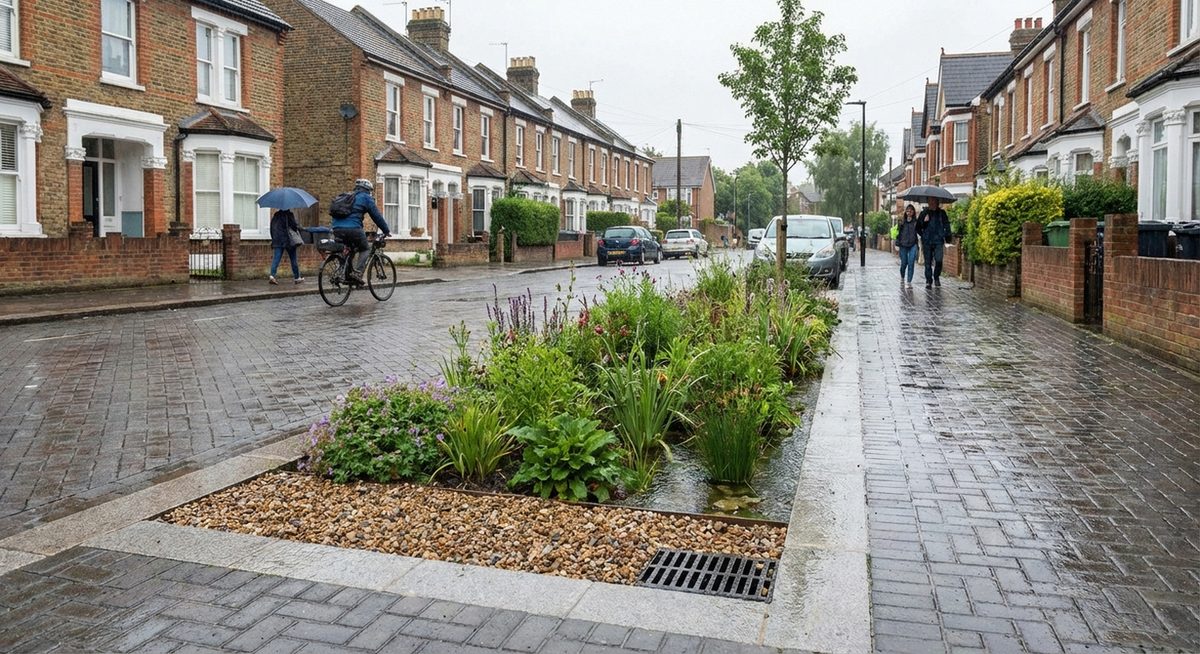
Rain Gardens
Shallow, planted depressions that collect runoff from roofs and paved areas. Water infiltrates the soil through the planted bed, with an overflow connection for extreme events.
Permeable Paving
Paving systems that allow water to pass through the surface and into a gravel sub-base. Water is either stored temporarily or infiltrates into the ground. Ideal for driveways, patios, and car parks.
Water Butts and Rainwater Harvesting
The simplest form of SuDS — collecting rainwater from roofs for garden use. Reduces both runoff volume and mains water consumption.
Conveyance Measures
These transport water slowly while providing treatment:
Swales
Shallow, grass-lined channels that replace traditional kerbs and pipes. Water flows slowly along the swale, allowing settlement and filtration.
Filter Strips
Gently sloping vegetated areas that treat runoff from impermeable surfaces through filtration and biological processes.
Storage and Treatment Measures
Detention Basins
Dry basins that temporarily store runoff during heavy rain and release it slowly. They double as amenity space in dry weather.
Retention Ponds
Permanent pools of water that attenuate peak flows and provide treatment through settlement and biological processes.
Constructed Wetlands
Engineered wetland areas that provide excellent water treatment through natural biological processes while creating valuable wildlife habitat.
Underground Storage (Geocellular Crates)
Modular plastic crate systems buried underground that store large volumes of water in a small footprint. Often used where space is limited.
Infiltration Measures
Soakaways
Pits or trenches filled with gravel or crates that allow collected water to slowly percolate into the surrounding ground. Effective where soil conditions allow (less effective in Suffolk’s clay soils without careful design).
Infiltration Trenches
Similar to French drains but designed primarily for infiltration rather than conveyance.
SuDS and UK Regulations
Planning Policy
The National Planning Policy Framework (NPPF) requires that new developments incorporate SuDS. Local planning authorities, including East Suffolk and Ipswich Borough councils, expect SuDS as part of planning applications for:
- Major developments (10+ dwellings or 1,000+ sqm)
- Developments in flood risk areas
- Any development that increases impermeable area
Building Regulations
Part H of the Building Regulations establishes a hierarchy for surface water disposal:
- Infiltration — Soakaways and similar (preferred)
- Watercourse — Discharge to a river or ditch
- Sewer — Connection to storm or combined sewer (last resort)
Lead Local Flood Authority (LLFA)
Suffolk County Council, as the LLFA, is a statutory consultee on surface water drainage for major developments. They publish guidance on SuDS design standards that developers must follow.
SuDS for Residential Properties
You don’t need a large development to benefit from SuDS. Here are practical measures for homes in Ipswich and Suffolk:
Replacing a Driveway
When replacing a driveway, choose permeable paving. Since 2008, you need planning permission to pave over a front garden with impermeable materials unless the water drains to a permeable area within your property.
Garden Redesign
Incorporate a rain garden to manage runoff from your roof and patio. A well-designed rain garden is attractive, low-maintenance, and highly effective at managing water.
Roof Drainage
Disconnect downpipes from the drainage system and redirect them to a rain garden, soakaway, or water butt. This reduces the load on your below-ground drainage.
Combining SuDS With Sump Pump Systems
Water discharged by your sump pump can be directed to a SuDS feature rather than a storm drain. This is particularly valuable where storm drain connections are limited or where you want to reduce your environmental impact. Learn about the broader picture in our article on zero carbon transition in drainage.
Benefits of SuDS
- Flood risk reduction: Slowing and storing runoff reduces peak flows
- Water quality improvement: Natural filtration removes pollutants
- Groundwater recharge: Infiltration replenishes aquifers
- Biodiversity: Green infrastructure creates wildlife habitat
- Amenity value: Green spaces improve property values and wellbeing
- Climate resilience: Vegetation provides cooling and absorbs carbon
- Reduced infrastructure costs: Less reliance on expensive pipe networks
Challenges and Limitations
- Clay soils: Suffolk’s clay soils limit infiltration rates, requiring careful design and potentially lined systems
- Maintenance: SuDS need regular maintenance to function properly — blocked inlets or overgrown vegetation reduces effectiveness
- Space requirements: Some SuDS features need significant space, which may not be available in urban settings
- Adoption: Uncertainty about who maintains SuDS long-term can be a barrier
- Cost perception: While often cheaper over their lifecycle, upfront costs can be perceived as higher
Frequently Asked Questions
Do I need SuDS for my extension?
If your extension increases the impermeable area of your property, Building Regulations require you to manage the additional surface water. SuDS features like a soakaway or permeable paving may be required.
How much do SuDS cost?
Costs vary widely. A simple rain garden might cost £500-£1,500, permeable paving £50-£100 per square metre, and a soakaway £500-£2,000. These are often comparable to or cheaper than traditional piped drainage.
Do SuDS work in clay soil?
Yes, but design must account for low infiltration rates. Lined SuDS that attenuate and slowly release water (rather than relying on infiltration) are effective in clay. Professional design is recommended.
Can SuDS replace a sump pump?
No. SuDS manage surface water before it enters the ground. A sump pump manages groundwater that has already reached your basement. They complement each other but serve different purposes.
Are SuDS difficult to maintain?
Most SuDS features require minimal maintenance — typically seasonal checks, debris removal, and occasional replanting. They’re generally less maintenance-intensive than traditional drainage systems.
Do SuDS add property value?
Yes. Properties with well-designed SuDS features, particularly rain gardens and quality permeable paving, are increasingly valued by buyers aware of flood risk and environmental issues.
Can I retrofit SuDS to an existing property?
Absolutely. Rain gardens, water butts, permeable paving for driveways, and disconnecting downpipes are all retrofit-friendly measures that can significantly improve your property’s drainage.
What’s the difference between SuDS and traditional drainage?
Traditional drainage moves water away as quickly as possible through pipes. SuDS slow water down, store it temporarily, allow some to infiltrate into the ground, and treat it naturally before release. SuDS work with nature rather than against it.
Expert Drainage Solutions
At Sump Plus, we integrate sustainable drainage principles with proven waterproofing solutions. Whether you need a sump pump, French drain, SuDS installation, or a combination approach, we design systems that are effective, sustainable, and compliant with current regulations.