Understanding How Sump Pumps Work
A sump pump is a mechanical device designed to remove water that has accumulated in a sump pit — a specially constructed basin at the lowest point of a basement or crawlspace. For homeowners in Ipswich, Suffolk, where ground conditions and weather patterns can lead to significant water ingress, understanding how these pumps work helps you make informed decisions about protecting your property.
This guide explains the mechanics behind sump pumps so you can better understand your drainage system and make informed decisions about your property.
The Basic Mechanics of a Sump Pump
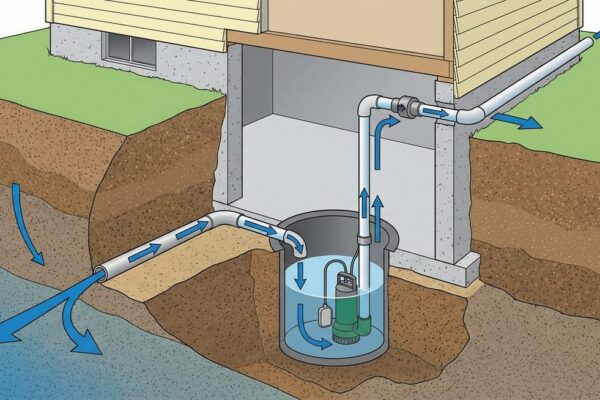
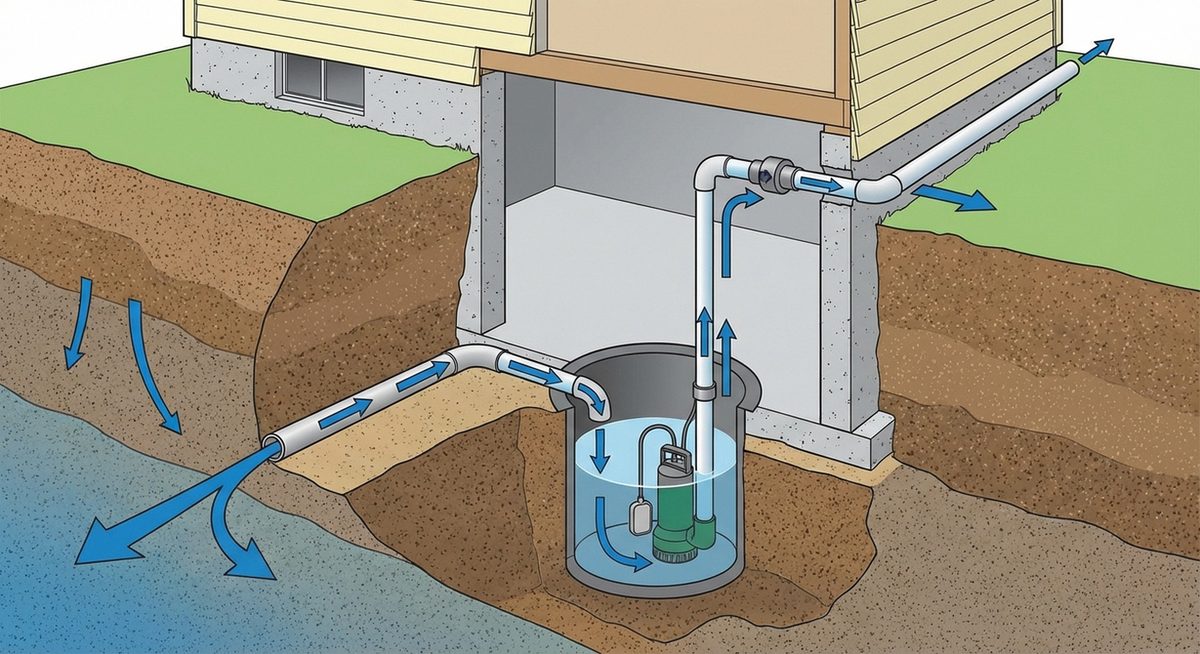
Every sump pump operates on the same fundamental principle: detecting rising water levels and mechanically moving that water to a discharge point away from the property. Here’s how the process works step by step:
- Water collection — Groundwater, rainwater, or seepage water flows into the sump pit through drain tiles, perimeter channels, or natural water migration through the soil.
- Level detection — As water rises in the pit, a float switch or pressure sensor detects the increasing water level.
- Pump activation — When water reaches the trigger point (typically 150-200mm from the bottom of the pit), the float switch activates the pump motor.
- Water removal — The pump’s impeller spins rapidly, creating centrifugal force that pushes water through the discharge pipe.
- Discharge — Water travels through the discharge pipe, past a non-return valve (check valve), and exits to a storm drain, soakaway, or other approved discharge point.
- Automatic shutoff — As the water level drops, the float switch deactivates the pump. The non-return valve prevents discharged water from flowing back.
Key Components Explained
The Impeller
The impeller is the heart of the pump. It’s a rotating disc with curved vanes that spins at high speed (typically 1,500-3,000 RPM). As it rotates, it creates a low-pressure zone at its centre that draws water in, then flings it outward and upward through the discharge outlet using centrifugal force.
The Motor
Sump pump motors are typically rated between 1/4 HP and 1 HP for residential use. The motor drives the impeller and is either:
- Oil-cooled — Sealed motors surrounded by oil for cooling and lubrication (common in submersible pumps)
- Air-cooled — Motors positioned above the water line that rely on ambient air cooling (common in pedestal pumps)
Float Switches
There are several types of float switch, each with distinct advantages:
| Float Switch Type | How It Works | Reliability |
|---|---|---|
| Tethered Float | A buoyant ball on a cord rises with water level | Good — simple mechanism, easy to replace |
| Vertical Float | A float slides up a vertical rod | Very good — less prone to tangling |
| Diaphragm Switch | Water pressure pushes against a rubber diaphragm | Excellent — no moving parts to jam |
| Electronic Sensor | Probes detect water conductivity | Excellent — most precise, but more expensive |
Non-Return Valve (Check Valve)
This critical component prevents water in the discharge pipe from flowing back into the sump when the pump switches off. Without it, the pump would cycle on and off continuously, wasting energy and reducing pump life.
The Sump Pit (Basin)
Modern sump pits are pre-formed from durable polypropylene or fibreglass. They typically feature:
- Perforated walls to allow water ingress from surrounding soil
- A sealed lid to prevent debris entry and reduce odours
- Inlet connections for perimeter drainage channels
- A flat base to support the pump securely
For more about sump pits and their role, read our comprehensive guide to sumps.
Types of Sump Pump and How They Differ
Submersible Sump Pumps
The pump and motor are housed in a single waterproof unit that sits inside the sump pit, fully submerged in water. The water surrounding the motor acts as a coolant, allowing these pumps to run for extended periods without overheating.
- Advantages: Quiet operation, space-saving, efficient cooling
- Disadvantages: More difficult to service, higher purchase cost
- Best for: Most residential basements, finished living spaces
Pedestal Sump Pumps
The motor sits on a column above the sump pit, with a long shaft extending down to the impeller at the base. Only the impeller and lower shaft are submerged.
- Advantages: Easier to service, longer motor life, lower cost
- Disadvantages: Noisier, takes up more space, less efficient
- Best for: Utility basements, narrow sump pits
For a detailed comparison of all pump types, see our guide to types of sump pumps explained.
Pump Performance: Understanding the Specifications
Flow Rate (Litres Per Hour)
This measures how much water the pump can move. Residential pumps typically range from 5,000 to 15,000 litres per hour. The right flow rate depends on your property’s water ingress volume.
Head Height
This is the maximum vertical distance the pump can push water. A pump rated at 8 metres head height can push water up to 8 metres vertically. Bear in mind that horizontal pipe runs and bends also reduce effective head height.
Power Rating
Measured in horsepower (HP) or watts. Most UK residential sump pumps are between 250W and 750W. Higher wattage doesn’t always mean better performance — an oversized pump wastes energy and cycles too frequently.
Electrical Requirements
Sump pumps have specific electrical requirements that must be met for safe, reliable operation:
- Dedicated circuit — The pump should have its own circuit, not shared with other appliances
- RCD protection — A residual current device is mandatory for any electrical installation in a wet environment
- Waterproof connections — All electrical connections near the sump must be IP-rated for wet conditions
- Battery backup — A battery backup system ensures the pump works during power cuts — precisely when flooding is most likely
What Happens During a Power Cut?
Power cuts during storms are common, and that’s exactly when your sump pump needs to work most. Solutions include:
- Battery backup pump — A secondary pump powered by a rechargeable battery, typically providing 4-8 hours of operation
- Water-powered backup — Uses mains water pressure to create suction and remove sump water (no electricity needed)
- Generator connection — A standby generator can power the primary pump during extended outages
We strongly recommend battery backup systems for all properties in flood-risk areas. Call to discuss backup options.
Common Sump Pump Problems
Pump Running Constantly
This usually indicates a stuck float switch, a check valve failure allowing water to flow back, or an undersized pump overwhelmed by water volume. Constant running dramatically shortens pump life.
Pump Not Activating
Check the power supply first, then the float switch. Debris can prevent the float from rising, or the switch contacts may have corroded.
Short Cycling (Rapid On/Off)
Often caused by a sump pit that’s too small, an oversized pump, or a float switch set incorrectly. The pump removes water faster than it can accumulate, then immediately reactivates when a small amount enters.
Vibration and Noise
Worn bearings, debris in the impeller, or a pump that’s not sitting level on the sump floor. Anti-vibration mounts and flexible discharge connections can reduce noise transmission.
Frequently Asked Questions
How long do sump pumps run for each cycle?
A typical cycle lasts 15-30 seconds for a residential pump. If your pump runs for more than a minute per cycle, it may be undersized for the water volume it needs to handle.
Should a sump pump run in dry weather?
If your pump activates occasionally during dry weather, this is normal — groundwater levels don’t always correlate with rainfall. However, if it runs frequently in dry conditions, you may have an underground water source or a plumbing leak.
Can I hear my sump pump running?
Submersible pumps are generally very quiet — a low hum is normal. Pedestal pumps are louder due to the exposed motor. Any grinding, rattling, or banging sounds indicate a problem that needs attention.
How much electricity does a sump pump use?
A typical 1/3 HP sump pump uses about 350-500 watts when running. Since it only runs intermittently, annual electricity costs are usually £20-£50. During wet periods, costs may increase slightly.
What size sump pump do I need for my house?
For most UK homes, a 1/3 HP pump with a flow rate of 7,000-10,000 litres per hour is sufficient. Larger properties, those with severe water ingress, or properties with a high discharge head may need more powerful pumps.
Do sump pumps need maintenance?
Yes, regular maintenance is essential. At minimum, test the pump quarterly and have it professionally serviced annually. See our sump pump maintenance checklist for a complete guide.
Can I connect a sump pump to the mains sewer?
In most areas, you cannot discharge surface water or groundwater into the foul sewer. It must go to a storm drain, soakaway, or watercourse. Check with your local water authority for specific regulations in your area.
What’s the difference between a sump pump and a sewage pump?
A sump pump handles clean groundwater and rainwater. A sewage pump (or macerator) handles foul water containing waste. They are different products with different specifications and regulations.
Need Help With Your Sump Pump?
Whether you need a new sump pump installed, an existing system serviced, or emergency pump repair, a qualified professional at Sump Plus is here to help. We serve Ipswich, Suffolk, and the wider East Anglia region with professional, reliable drainage solutions.